Two suppliers can look at the same digital project and return quotes tens of thousands of pounds apart. That does not automatically mean one is overcharging or the other is cutting corners. Often, you are buying two completely different delivery structures.
A traditional agency may bring an account manager, project manager, strategist, designer, developer, copywriter, SEO specialist and QA engineer. An AI-native micro-agency brings a much smaller senior team, backed by systems and purpose-built AI agents that increase its capacity.
Both models can work. The useful question is not “which sounds more impressive?” It is:
Which operating model gives this project the right expertise, pace, accountability and risk for the money?
Here is the honest comparison we would want to read before spending our own money.
The short answer
Choose a traditional agency when the project genuinely needs a broad team working across many specialist tracks at once, formal procurement capacity or continuous service cover.
Choose an AI-native micro-agency when the problem is focused, senior attention matters, and you want the people making the decisions to stay close to the work.
Happy Webs sits in the second category. We are two founders, backed by AI agents we have built around our delivery process. The agents help with suitable repeatable work. Chris and Kay own the decisions, client relationship and quality of everything that ships.
That structure means fewer handovers, less time translating the brief between departments and lower fixed overhead. It is designed to make good work faster and more affordable for SMEs. It is not a claim that AI makes every task instant or every project cheaper.
What you pay for at a traditional agency
Traditional-agency pricing is not just the cost of design or code. It also pays for the organisation around the work:
- account and project management;
- discovery, strategy and creative direction;
- separate design, development, content and search teams;
- internal reviews and handovers;
- offices, management, sales and other fixed costs;
- spare capacity and the ability to replace people;
- specialist support, procurement and compliance functions.
Those things can be valuable. If you need a multilingual launch across six markets, a large content operation and a 24-hour service desk, that structure is an advantage.
For a focused SME website, custom system or automation project, however, the number of layers can become disproportionate. Every handover creates another meeting, another interpretation of the brief and another person whose time has to appear somewhere in the price.
A public UK government supplier rate card illustrates how quickly a multi-role team can accumulate cost: separate consultant, project management, UX, content, technical lead, development and QA rates range from £650 to £850 per day. That is one supplier’s structure, not a UK market average, but it shows why a project staffed across many roles becomes expensive before much has been delivered.
What “AI-native micro-agency” means in practice
It does not mean handing your business to a chatbot. It does not mean pressing a button and publishing whatever comes out.
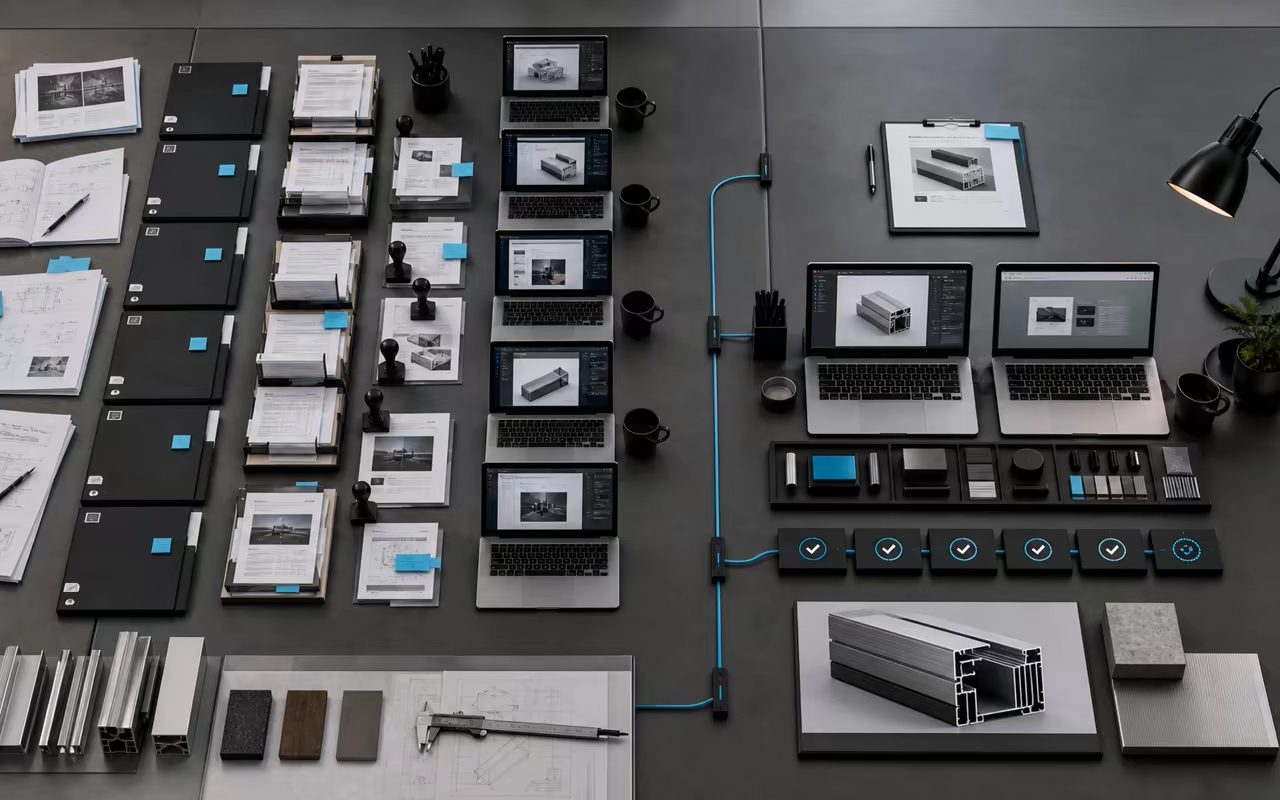
We use a named bench of purpose-built AI employees for bounded tasks such as:
- researching a market or technical question;
- producing first drafts for a human to challenge;
- handling repetitive implementation work;
- expanding test coverage and checking edge cases;
- reviewing pages for consistency, accessibility and search basics;
- preparing documentation and operational checks.
This gives two experienced people more delivery capacity. It also leaves more human time for discovery, architecture, design judgement, commercial decisions and speaking directly to the client.
The distinction matters:
AI does the repeatable work. Humans own the decisions.
Research supports the potential, but not the hype. The UK Government’s AI Adoption Research found that 75% of surveyed AI-using businesses reported improved workforce productivity, while 34% reported lower operating or production costs. Those are self-reported business outcomes, not a promise that every software project becomes 75% faster or 34% cheaper.
Software-delivery evidence is mixed too. Some controlled and field studies have found meaningful gains. A METR study of experienced open-source developers found the opposite: developers using early-2025 AI tools were 19% slower on the measured tasks, even though they believed they were faster.
That is why the operating discipline matters more than the tool. We use AI where it improves the work, then combine it with human review, automated tests, small releases and direct client feedback.
Why the micro-agency model can move faster
Speed does not come from typing code faster. It comes from shortening the distance between a business decision and a working release.
In a layered delivery model, a client request can move from account manager to project manager to discipline lead to the person doing the work, then back through QA and the same chain again. Each handover may be sensible, but each one adds waiting and interpretation.
In our model, the people in the client conversation are also close to strategy, design and implementation. A question can be answered while the context is still fresh. A useful first version can be released in a smaller batch, measured and improved.
Google’s DORA research recommends working in small batches because smaller changes reduce feedback time and make problems easier to isolate. AI can increase output, but without those delivery habits it can simply create a larger pile of work to review.
This is the part of “faster” that buyers should inspect. Ask an agency:
- Who will be in the room after the sale?
- Who makes implementation decisions?
- How often will you see working progress?
- How many internal handovers sit between feedback and a change?
- What gets tested before release?
The answers tell you more than an AI badge on a capabilities deck.
The £40,000 versus £27,000 example
On one recent project, other agency proposals ranged from £40,000 to £80,000 depending on the supplier and scope. Our agreed price was £27,000.
The fair comparison is against the lowest £40,000 proposal:
| Comparison | Amount |
|---|---|
| Lowest traditional-agency proposal | £40,000 |
| Happy Webs delivery | £27,000 |
| Cash difference | £13,000 |
| Percentage lower | 32.5% |
That is about a third less. It is not 40% less, and we will not massage the denominator to make the headline bigger.
It is also one project, not an audited average. A proper comparison must normalise the deliverables, integrations, migration, support, licences, hosting, VAT and risk. The £80,000 proposal should not be used to claim a 66% saving unless its scope was materially the same.
Our lean model is designed to cost less than a larger multi-layer agency on the kind of focused work we do. We are not publishing “40% cheaper on average” until there is a large enough like-for-like dataset to support it.
The better promise is simpler: send us the outcome, and we will give you a written fixed scope with the assumptions visible.
What we do not delegate to AI
Lower overhead should never mean lower accountability.
At Happy Webs, the named human team remains responsible for:
- understanding the commercial problem;
- deciding what should and should not be built;
- architecture, security and data handling;
- reviewing generated code and content;
- accessibility, testing and release decisions;
- communicating trade-offs to the client;
- the final quality of the delivered work.
We also treat business data as a design constraint, not an afterthought. The ICO’s AI and data-protection guidance stresses security and data minimisation. A credible supplier should be able to explain what data is used, where it goes, which provider processes it and where human approval is required.
Ask those questions of us. Ask them of any agency using AI. “We use AI” is not a security policy.

Proof matters more than the agency label
Small does not automatically mean effective, just as large does not automatically mean safe. The only useful test is whether the team has delivered relevant work and can explain how it was done.
Our strongest example is Kingsland Fabrications. What began as a website became a custom manufacturing execution system and production-AI programme. A paint-note workflow that took up to roughly two supervisor-hours per day was reduced to near zero. The system replaced a physical Kanban board and fragmented tools with a workflow built around the fabrication shop.
For Avanti Doors, we handled a Google Workspace migration, Gemini adoption and a full Astro website rebuild. The site achieved 100 scores across the four measured Lighthouse categories and the relationship continued phase by phase.
For CRB Door Systems, the first job was a dormant website. That became an enquiry-focused rebuild, a Workspace migration and the start of a custom stock-management system.
These are different disciplines, but the relationship stays with the same small senior team. The client does not have to re-explain the business every time the work crosses a departmental line.
See all case studies or read how we work before deciding whether that model suits you.
When a traditional agency is the better choice
We are not the right supplier for every procurement. Choose a larger agency if you need:
- many workstreams running in parallel;
- round-the-clock service cover and a formal escalation rota;
- a large volume of research, content or campaign production;
- deep in-house specialisms across several markets or languages;
- specific procurement frameworks or regulated-delivery accreditations;
- enough spare staff to absorb key-person absence without changing pace.
A credible micro-agency should address its own risks too: limited simultaneous-project capacity, key-person dependency, holiday cover, specialist subcontracting, support expectations and handover documentation.
We manage those risks through focused project capacity, clear scope, documented systems, source-code handover, appropriate specialists and honest support terms. But if your buying criteria demand the bench strength of a 100-person firm, you should buy that bench strength.
When the micro-agency model fits
The model is strongest when:
- one commercially important problem needs solving well;
- the client wants direct access to experienced people;
- the scope crosses website, software, search or automation boundaries;
- releasing a useful first phase matters more than a long reveal;
- the business values fixed scope and visible assumptions;
- continuity of context matters;
- lower overhead should translate into more budget reaching the work.
UK SMEs are not short of tools. They are short of time, implementation capacity and reliable advice. Government research into technology adoption among UK SMEs found that businesses value reliable, personalised support and often find adoption too difficult, expensive or risky.
That is the job our model is designed to do: turn one important digital problem into a sensible first scope, deliver it with senior attention and earn the next phase.
Compare us properly
Do not choose Happy Webs because “AI agency” sounds modern. Choose us if the operating model matches the job.
Bring us the brief—or the proposal you already have. We will tell you:
- what outcome the scope is really buying;
- which items are necessary now and which can be phased;
- where the risk and hidden assumptions sit;
- what we would deliver for a fixed price;
- and whether we are genuinely the right-sized team.
If we can remove waste, we will show you where. If the larger agency has priced a team you actually need, we will tell you that too.
What people ask about this.
What is an AI-native micro-agency?
An AI-native micro-agency is a small, senior human team that uses purpose-built AI agents and automation to increase delivery capacity. The agents can help with bounded work such as research, first drafts, repetitive code, tests, documentation and checks, while named people remain responsible for strategy, security, quality and the client relationship.
Is an AI micro-agency always cheaper than a traditional agency?
No. Price depends on the scope, risk, support and specialist skills required. A micro-agency can often cost less on a focused project because it has lower fixed overhead and fewer management layers, but every comparison should be made like-for-like.
Who is responsible for work produced with AI?
At Happy Webs, Chris and Kay remain responsible for the brief, decisions, implementation, review and client relationship. AI agents assist the work; they are not presented as autonomous employees and they do not remove human accountability.
How should I compare two agency proposals?
Compare the deliverables, assumptions, integrations, content, testing, data migration, licences, hosting, support period, change process and whether VAT is included. A lower headline price is not meaningful if the scope is smaller or the ongoing costs are hidden.
When is a traditional agency the better choice?
A larger agency is often the better fit when you need many parallel workstreams, round-the-clock support, multi-market campaign production, formal procurement frameworks or numerous specialist disciplines available at the same time.
Send the brief or an existing proposal. We will show what we would keep, remove or phase, then give you a fixed scope to compare.
Compare my scopeTell us what you want to improve →
Also relevant: Custom Software & AI