The latest UK evidence tells a more useful story than the usual AI hype.
AI use is rising quickly, but most businesses are still experimenting at the edges. The Office for National Statistics reported on 20 July 2026 that the share of UK businesses with 10 or more employees using at least one AI technology had risen from about 12% in late 2023 to about 35% in June 2026.
But adoption is still shallow. The average adopting business uses only 1.6 AI technologies, up from 1.4 in 2023, and just 10% say they use AI extensively.
For a manufacturing SME, that gap is the opportunity. You do not need to build an autonomous factory. You need to find one expensive, repeated problem that AI can help your existing team solve safely.
The government’s new AI Adoption Plan for Advanced Manufacturing gives that approach a useful name: Scan–Pilot–Scale.
This guide turns that national plan into something a 15, 30 or 50-person manufacturer can actually use.
Send us the repeated admin or production-information job that wastes the most time. We will help you judge the value, risk and smallest sensible pilot.
What the July 2026 data actually tells us
Three numbers matter.
35% are using AI, but only 10% use it extensively
The ONS data shows rapid adoption among businesses with 10 or more employees. It also shows that most use is limited rather than transformational.
That distinction matters. Paying for an AI assistant and asking it to rewrite the odd email counts as adoption. It does not mean AI is connected to quoting, purchasing, job tracking, quality or production data.
The opportunity is not to collect more AI subscriptions. It is to move one useful workflow from occasional experimentation into dependable daily use.
Business operations are the main target
Improving operations is the most common purpose reported by larger AI-using businesses. That fits what we see in manufacturing: the strongest early projects are usually not public chatbots or marketing gimmicks. They are internal jobs such as:
- Checking supplier invoices against purchase orders
- Extracting dimensions, finishes or part details from documents
- Finding the latest status of a job without chasing a supervisor
- Preparing quote information from previous work
- Routing customer enquiries to the right person
- Flagging inspection photos that need a second look
These workflows have a beginning, an end and a result you can measure.
UK manufacturing has a deployment problem, not an ideas problem
The government’s manufacturing plan says the sector contributes around £234 billion a year to the UK economy and supports 2.5 million jobs. It also identifies the barriers holding industrial AI back: fragmented data, legacy systems, uncertain returns, skills gaps, integration risk and difficulty moving beyond pilots.
That is a fair diagnosis. The model is rarely the hardest part. The hard part is making the system work with your documents, rules, people and existing software every day.
Where AI is already useful in a small factory
AI is not one product. Different tools suit different problems, and they carry different levels of risk.
| Use case | Sensible SME starting point | Risk level | What to measure |
|---|---|---|---|
| Document processing | Read invoices, POs, delivery notes or drawings and prepare structured data for review | Low to medium | Minutes saved, fields corrected, exceptions caught |
| Internal assistant | Answer job-status or process questions from approved company data | Low to medium | Questions answered, supervisor interruptions avoided |
| Quote support | Find similar jobs and prepare a draft scope or cost inputs | Medium | Quote turnaround, corrections, win rate |
| Visual quality support | Flag inspection images for a trained person to review | Medium to high | Defects found, false alerts, inspection time |
| Predictive maintenance | Combine reliable machine and maintenance data to identify warning patterns | High | Downtime avoided, false alerts, maintenance cost |
| Autonomous control | Allow software to change machinery or safety-critical production steps | Very high | Not a sensible first SME pilot |
The safest early projects support a person rather than replacing a decision. They reduce searching, copying, checking and chasing while leaving approval with someone who understands the job.
If documents are the bottleneck, see our guide to AI document processing. If supervisors lose time answering routine job questions, the shop-floor AI assistant use case shows what a more connected system can do.
Scan: find the workflow with a real return
The first stage is not a software demo. It is a short operational scan.
List five repeated jobs that consume time, create errors or delay customers. Score each one from 1 to 5 against these questions:
- Frequency: Does it happen every day or every week?
- Time: How many paid hours does it consume each month?
- Consistency: Are the inputs and expected output reasonably clear?
- Checkability: Can a person quickly tell whether the result is right?
- Containment: If the AI is wrong, can you stop the mistake before it affects safety, money or a customer?
- Data readiness: Do you have enough real examples to test?
A good first pilot scores highly on frequency, time, checkability and containment. It does not need perfect data. It does need enough real examples to expose the awkward cases.
A simple return calculation
Use this before discussing features:
Monthly value = hours removed × real hourly cost + errors avoided + faster cash or quoting
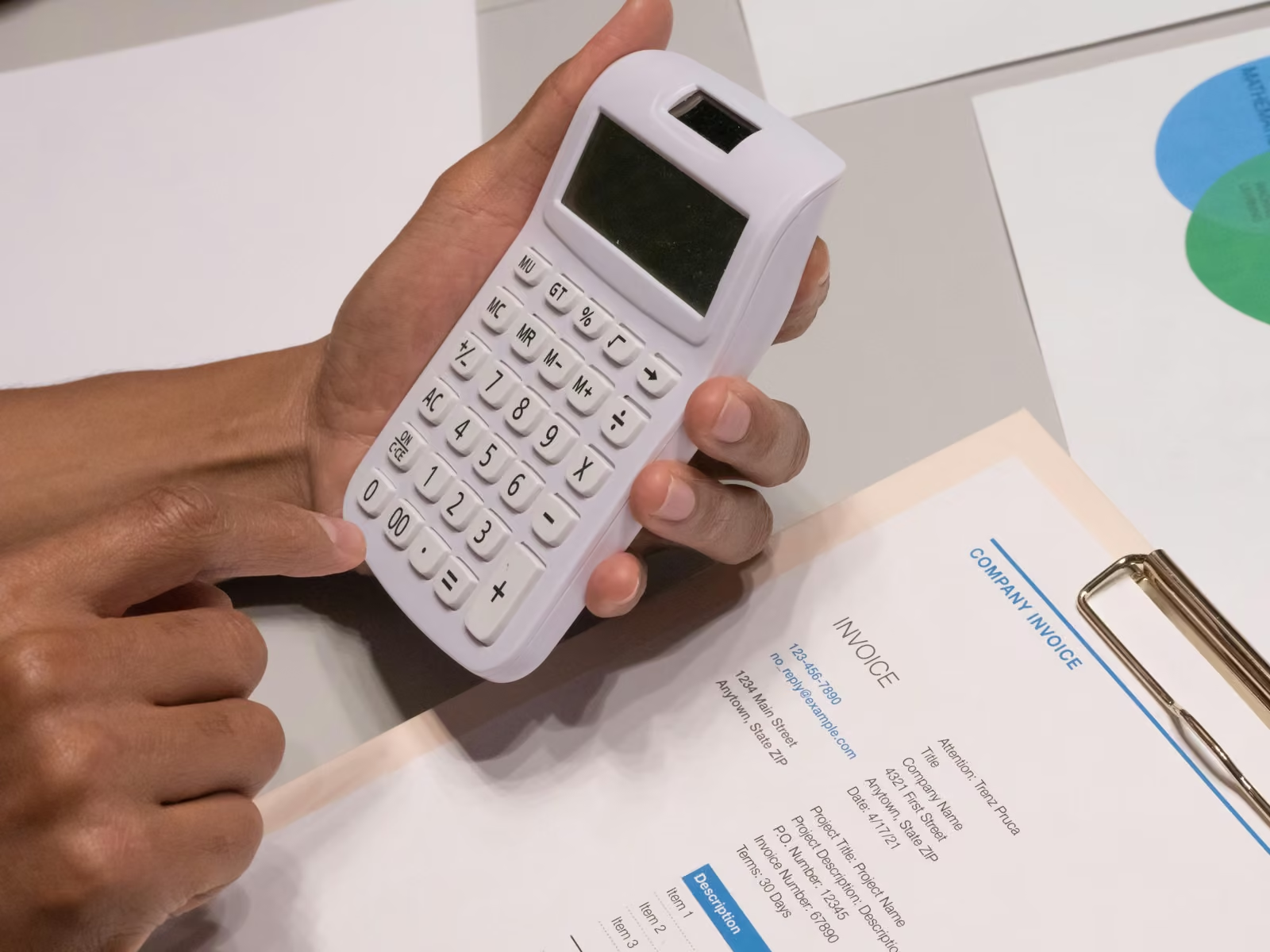
If a workflow consumes 40 hours a month at a loaded cost of £25 an hour, the time cost is already £1,000 a month. If it also delays quotes or misses invoice discrepancies, the real value is higher.
That does not automatically justify a large build. It gives you a ceiling. A £5,000 pilot that safely removes most of a £12,000 annual problem has a credible case. A £20,000 platform aimed at a £2,000 problem does not.
Pilot: prove it beside the current process
A useful pilot should be small enough to fail safely and realistic enough to teach you something.
Use real work, not a polished demo
Test the good examples and the ugly ones:
- The scanned invoice with a coffee mark
- The revised drawing with an old filename
- The purchase order with a split delivery
- The job number typed differently by two departments
- The customer email that mixes three requests together
Clean demo data proves almost nothing about operational reliability.
Run in shadow mode
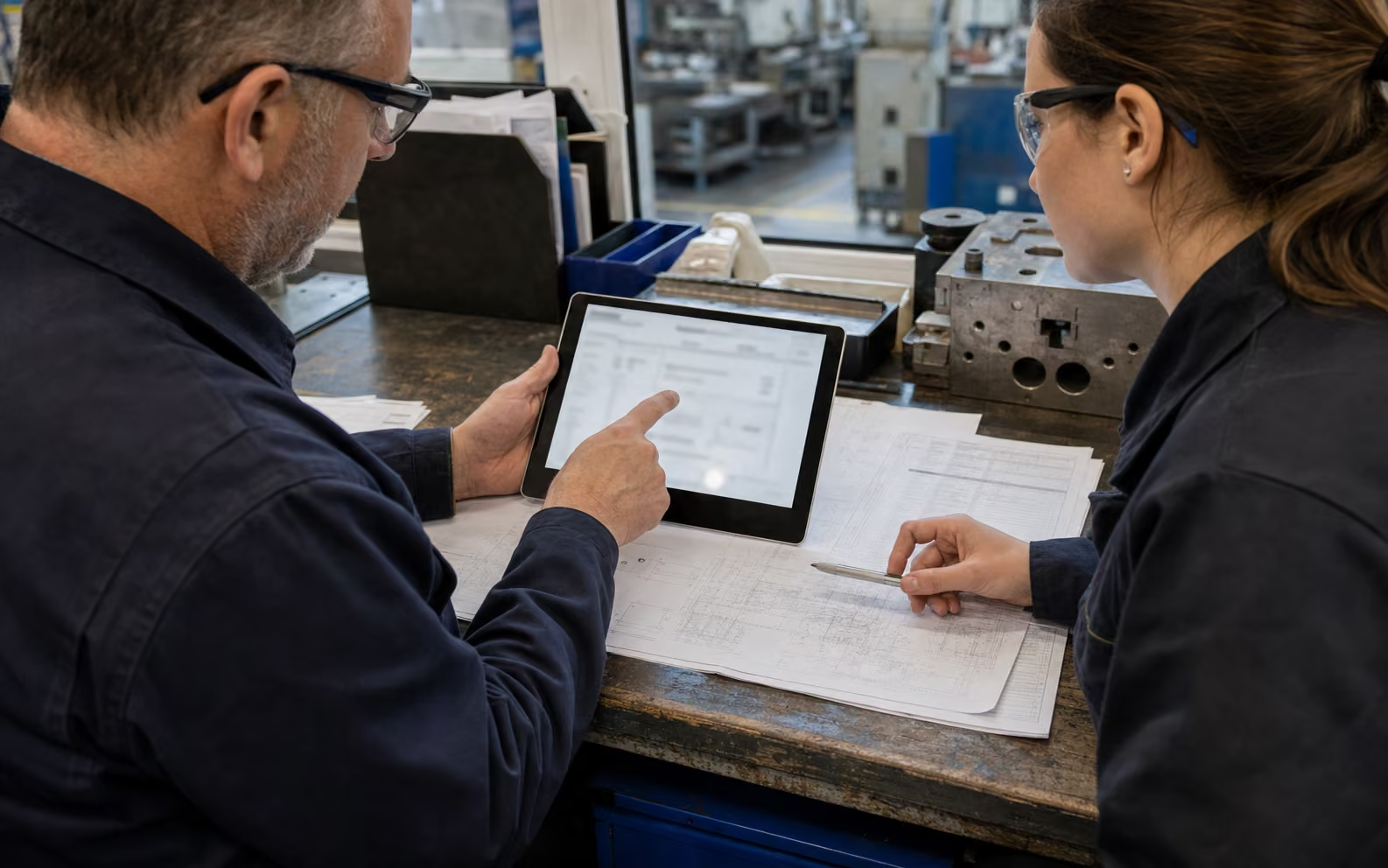
For the first few weeks, let the AI prepare an answer without acting on it. Your team completes the process as normal and compares the two results.
Track:
- Correct results
- Results that needed a small correction
- Unsafe or unusable results
- Cases the system correctly refused or escalated
- Time taken before and after
This creates evidence and gives the team time to build trust. In our applied AI work with a UK fabricator, shadow operation and clear confirmation steps mattered as much as model accuracy. The 12-month retrospective explains what that looked like in practice.
Set a stop rule before you start
Agree what would make you stop, change direction or keep the process manual. Examples include:
- Accuracy stays below the agreed threshold after representative testing
- Staff need longer to check the output than doing the job themselves
- The source data is too inconsistent to use safely
- Integration cost removes the likely return
- The workflow touches safety-critical decisions that need a different assurance process
A stopped pilot can still be a good result. It is cheaper than forcing the wrong tool into production.
Scale: connect only what has earned trust
Scaling does not mean switching on ten more AI tools. It means making the proven workflow dependable.
That usually includes:
- Named owners for the workflow and its data
- Role-based access to documents and systems
- Logs showing what the system read, produced and changed
- Clear escalation when confidence is low
- Version control for prompts, rules and reference material
- Monitoring for recurring failures
- A manual route when the system is unavailable
- Training for the people who use and supervise it
Only after one workflow is stable should you reuse the same foundations for the next one.
For example, a reliable document pipeline can later support invoice matching, cutting-list extraction and material-certificate checks. A secure internal data layer can later support job lookup, customer updates and reporting. The expensive plumbing starts earning value across several workflows.
A practical 30-day manufacturing AI pilot plan
Week 1: map and measure
- Choose one workflow
- Record current time, volume, error and delay
- Collect 30 to 100 representative examples
- Mark the decisions that must stay human
- Write down what success and failure mean
Week 2: build the narrowest useful version
- Connect only the minimum data source
- Produce a draft, flag or structured output
- Add an approval step
- Log every result
- Test obvious failure cases
Week 3: run in shadow mode
- Compare AI output with the current process
- Record corrections and exceptions
- Ask the people doing the job where it creates friction
- Improve rules, source data and escalation
Week 4: decide with evidence
- Calculate time saved after checking
- Review error types, not only the average accuracy
- Decide whether to stop, extend the pilot or go live with limits
- Set an owner, review date and next measurable target
That is enough to learn whether a project deserves more money. It is not enough to hand control of machinery or a safety-critical decision to AI.
Cost, funding and what to buy first
For a focused workflow, our AI agent projects start from about £2,000. Projects involving several systems, custom document processing or a longer monitored pilot are more often £5,000 to £15,000. The UK AI consultant pricing guide explains the wider market and what changes the cost.
Buy as little as the first test needs. That may be:
- A secure AI service
- Storage you already use
- One workflow or integration layer
- A simple review screen
- Logging and alerts
It should not automatically mean a new ERP, factory-wide sensors or an “AI platform”.
Funding may reduce the upfront cost. The current national advanced manufacturing offer lists £116 million for Made Smarter support aimed at 5,500 SMEs, including advice, training and help adopting technologies such as AI, automation and robotics. In the North West, Made Smarter announced a further £2.5 million of support from April 2026.
Check the current regional offer and eligibility before building a funding-dependent business case. Our Made Smarter guide explains how to prepare for that first conversation.
Safety, data and the human approval line
Manufacturing AI can touch commercially sensitive drawings, customer data, pricing, employee information and production systems. Governance cannot wait until after the demo.
The UK Business Data Survey 2026 found that only 17% of AI-using businesses had formal or informal AI guidance, and only 5% had a formal written policy. That is a thin control layer for technology that may access internal files.
At minimum, document:
- Which tools staff may use
- Which data must never be uploaded
- Who owns each AI-assisted process
- Where human approval is required
- How outputs are checked and logged
- What happens when the system fails
- How access is removed when roles change
The National Cyber Security Centre recommends a secure-by-design approach: security belongs in the project from the start, with clear accountability and a plan for failure. If personal data is involved, use the ICO’s current AI and data protection guidance and take proportionate professional advice.
For machinery control, worker monitoring, safety decisions or regulated products, general AI workflow advice is not enough. Use the relevant engineering, safety, employment and legal expertise.
Seven questions to ask an AI supplier
- What exact workflow are we improving, and what will stay unchanged?
- Which of our systems and data will the tool access?
- Where does a named person approve the result?
- How will we test failure cases and measure corrections?
- Can we see logs for what the system read and produced?
- What happens if the model, integration or internet connection is unavailable?
- Who owns the workflow, data and outputs if we stop working together?
If the answer is a product tour rather than an operational explanation, keep looking.
The sensible July 2026 conclusion
The current UK data does not say every factory needs an AI transformation programme.
It says adoption is moving quickly, depth is still limited and manufacturers need a safer route from interest to everyday value. Scan–Pilot–Scale is useful because it starts with the problem, proves the result and makes expansion conditional on evidence.
For most manufacturing SMEs, the first win will be unglamorous: fewer invoices checked by hand, faster access to job information, less quote admin or fewer hours spent moving data between systems.
That is exactly why it is worth doing.
In a free 15-minute intro call, we will help you identify the smallest credible pilot, the checks it needs and whether the likely return justifies building it.
Frequently asked questions
How are UK manufacturers using AI in 2026?
Practical uses include reading and checking invoices, purchase orders and drawings; helping teams find job information; drafting quotes and customer updates; identifying quality issues from images; forecasting demand; and predicting maintenance needs. For most SMEs, document and workflow automation is a safer first project than robotics or autonomous machinery.
What is the best first AI project for a small manufacturer?
Choose one repeated workflow with clear inputs, a clear output, enough monthly volume to matter and a human who can check the result. Supplier invoice matching, drawing extraction, quote administration and job-status lookups are strong starting points because the result is measurable and mistakes can be contained.
How much does a manufacturing AI pilot cost?
A focused workflow automation can start from around £2,000. A more involved pilot with custom document processing, integrations and a monitored trial commonly costs £5,000 to £15,000. Scope should be based on the value of the time and errors removed, not the novelty of the technology.
Is funding available for manufacturing AI projects?
Made Smarter provides advice, digital roadmapping, training and, for eligible manufacturers, match-funded support. Availability and eligibility vary by region and funding round, so check the current Made Smarter offer before committing to a project.
Should AI be allowed to control factory machinery?
Not as a first SME pilot. Begin with decision support and administrative workflows, keep a named human approval point and test the system in shadow mode. Safety-critical or machinery-control uses require specialist engineering, formal risk assessment, appropriate standards and much stronger assurance.
Sources and further reading
- Artificial intelligence in UK businesses: 2023 to 2026 — Office for National Statistics
- AI Adoption Plan: Advanced Manufacturing — UK Government
- UK Business Data Survey 2026 — UK Government
- AI and cyber security: what you need to know — National Cyber Security Centre
- AI and data protection guidance — Information Commissioner’s Office
What people ask about this.
How are UK manufacturers using AI in 2026?
Practical uses include reading and checking invoices, purchase orders and drawings; helping teams find job information; drafting quotes and customer updates; identifying quality issues from images; forecasting demand; and predicting maintenance needs. For most SMEs, document and workflow automation is a safer first project than robotics or autonomous machinery.
What is the best first AI project for a small manufacturer?
Choose one repeated workflow with clear inputs, a clear output, enough monthly volume to matter and a human who can check the result. Supplier invoice matching, drawing extraction, quote administration and job-status lookups are strong starting points because the result is measurable and mistakes can be contained.
How much does a manufacturing AI pilot cost?
A focused workflow automation can start from around £2,000. A more involved pilot with custom document processing, integrations and a monitored trial commonly costs £5,000 to £15,000. Scope should be based on the value of the time and errors removed, not the novelty of the technology.
Is funding available for manufacturing AI projects?
Made Smarter provides advice, digital roadmapping, training and, for eligible manufacturers, match-funded support. Availability and eligibility vary by region and funding round, so manufacturers should check the current Made Smarter offer before committing to a project.
Should AI be allowed to control factory machinery?
Not as a first SME pilot. Begin with decision support and administrative workflows, keep a named human approval point and test the system in shadow mode. Safety-critical or machinery-control uses require specialist engineering, formal risk assessment, appropriate standards and much stronger assurance.
We build custom software and bespoke AI tools around how your business works: customer portals, quote systems, internal tools, document checks and connected workflows. If an existing product does the job, we will recommend it. AI belongs where it adds value, with your rules and approvals built in.
Explore the serviceTell us what you want to improve →
Also relevant: AI Agents