Agent-readiness baseline audit
Review discoverability, machine-readable content, action endpoints, MCP or OpenAPI coverage, permissions, approvals and error handling

Agent readiness · Safe actions
Help AI assistants find your services and prepare useful requests, such as a quote enquiry or product shortlist. Customers review the details and confirm before anything is sent or changed.
£1,495 excluding VATAgent Readiness Audit + Roadmap · See what is included

The starting point
Start with the thing that costs you time, enquiries or confidence. We shape the work around it.
A contact form makes sense to a person, but an agent needs a clear description of what the action does, which fields are required and what happens next.
Internal endpoints, booking tools and quote workflows may already exist, but inconsistent schemas and missing documentation make them unreliable or unsafe for agent tool use.
Submitting personal data, sending a message or changing a record should not happen invisibly. The workflow needs consent, validation, authentication and a human confirmation point appropriate to the risk.
Without logs, rate limits, useful errors and a fallback route, a failed tool call becomes a lost enquiry or a silent operational problem.
The work in context · Illustrative scenes

Give an assistant clear information and a small, documented interface, then keep approval and failure handling visible.

A viewing or maintenance enquiry can be assembled for review before the customer chooses to send it.
What we do
From a one-off project to ongoing support. We agree which services you need, what we will deliver and the cost before work starts.
Review discoverability, machine-readable content, action endpoints, MCP or OpenAPI coverage, permissions, approvals and error handling
Publish concise service, pricing-band and process information at stable URLs that software clients can retrieve and interpret
Configure appropriate robots directives, content signals, Link headers, llms.txt files and well-known discovery routes where the platform supports them
Describe useful actions such as request a quote, prepare an enquiry or check availability through a consistent agent-skills index
Expose the agreed read or action capabilities through a focused Model Context Protocol server when MCP is the right fit
Document HTTP actions with an OpenAPI contract and API catalogue so inputs, outputs and failure states are explicit
Keep the user in control before personal data is submitted, messages are sent or consequential actions are performed
Add scoped credentials, validation, rate limits and allow-listed actions appropriate to the data and operational risk
Make calls traceable, return useful errors and give the user a normal web route when an agent action cannot complete
Test discovery and actions against the agreed contract, document the result and show your team how to monitor and maintain it
A technical result
Kingsland Fabrications scored 100/100 on the published agent-readiness scan. This verifies technical discovery signals; it does not guarantee recommendations or prove every agent action is safe.
Re-run the scan ↗︎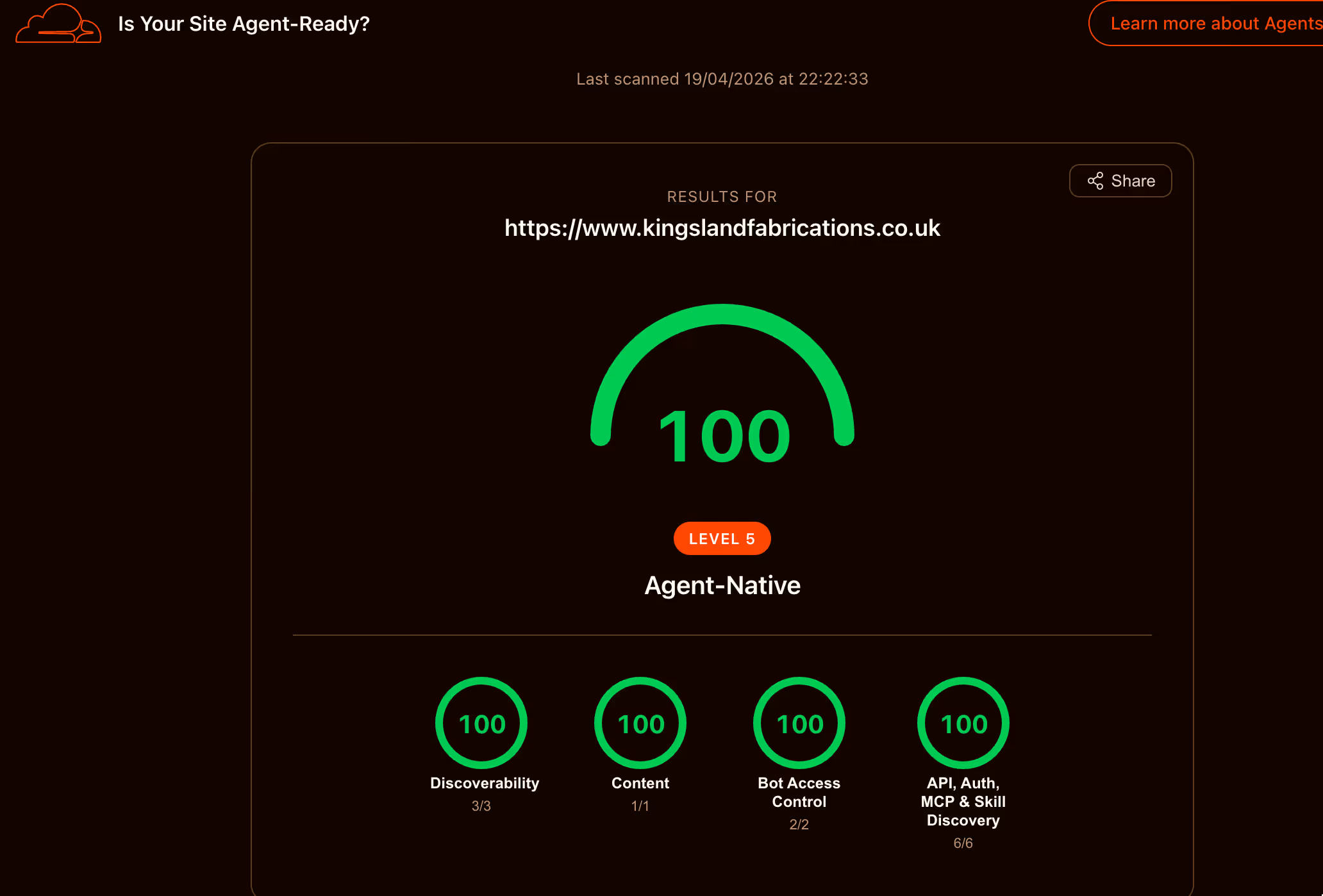
How it happens
We check discoverability, machine-readable content, available actions, permissions, interfaces and failure handling against the live site.
We publish the agreed discovery files, content routes, service summaries and action descriptions, then verify that clients can retrieve them.
Where useful, we build the MCP or OpenAPI interface with validation, approval, authentication, logging and a safe web fallback.
We run discovery and action tests, document the contract and show the team how to monitor errors, permissions and future changes.
Cost and commitment
Start with a free technical scan or a £1,495 Agent Readiness Audit and 90-Day Roadmap. Foundations work starts from £1,500. A focused MCP, OpenAPI or agent-action build starts from £4,500 once the action, data and approval boundary are clear. Ongoing monitoring starts from £750 per month where the interface is operationally important.
Your quote sets out the scope, timescale and support. We share progress early and check the work before launch.
All prices exclude VAT. Final scope and price agreed in writing.
£1,495excluding VAT
Free
From £1,500excluding VAT
From £4,500excluding VAT
From £750/monthexcluding VAT
Not every website needs MCP or callable actions. If stable pages and a normal form already serve the user well, we will say so and stop at the useful foundations.
An outline is enough. We will help you find the useful first move.
Before you decide
An agent-ready website publishes information and actions in predictable, documented formats that software agents can discover and use. Depending on the need, that can include stable machine-readable pages, a skills index, an OpenAPI contract or an MCP server, with consent and safety controls around actions.
Generative Engine Optimisation helps a business become a useful source inside AI-generated answers. Agent Readiness focuses on discovery and safe action: can an agent understand the available capability, call the right interface and complete a task with the user in control?
AI agents are software workers we build to carry out a business workflow such as triaging enquiries or routing documents. Agent Readiness prepares a website or service so an external or internal agent can discover and use its approved capabilities. One is the worker; the other is the interface and safety layer.
SEO helps pages appear in traditional search results and earn visits. Agent Readiness does not target rankings. It makes selected information and actions accessible through machine-readable routes and documented tools.
Kingsland Fabrications scores 100 out of 100, Level 5 “Agent-Native”, on the agent-readiness scan used for this service. The technical score proves the discovery layer is present; any operational action is still tested separately against its own inputs, permissions and outcomes.
Model Context Protocol is a way to expose data and tools to compatible AI clients. You may need an MCP server when an approved agent must retrieve live information or perform a defined action. You do not need one merely because the website has content; a normal page or documented HTTP API can be the simpler answer.
Yes, if the workflow is deliberately built for that action. The tool should show the user the completed enquiry, require confirmation before sending, validate the data and return a clear receipt. We do not treat silent form submission as a good agent experience.
Yes. Well-known discovery paths, API contracts, MCP servers and machine-readable content can be implemented on many platforms. Some conveniences are hosting-specific, so the audit separates portable standards from optional platform features.
We verify that the discovery route resolves, the schemas validate and a compatible client can understand the declared capability. For actions, we test valid requests, invalid requests, approval points, authentication, logs, errors and the fallback experience. A high site scan alone does not prove an action is safe.
For the audit, we need the live website and a short call about the action you want an agent to support. Implementation normally needs website or repository access, API documentation, a technical owner for connected systems and a decision on consent, permissions and who approves sensitive actions.
The automated scan is quick and useful for spotting technical gaps, so we make that first check available without forcing a project. The paid audit adds workflow mapping, permission and risk decisions, interface review and a practical implementation plan.
Yes, but structured data is only one layer. An agent may also need a stable content route, a discovery file, a tool contract and a secure endpoint. We choose the smallest stack that supports the real action instead of adding every possible protocol.
Keep exploring
Related services and real examples to help you choose the next step.
A new website. More customers. Less admin.
Tell us where you want to get to. We will reply within one working day.