What we need to see
One repeatable process with its trigger, current handovers, required approvals and common failure cases.

Workflow automation · Manufacturers
Manufacturing runs on workflows that already exist in everyone's heads. We make them explicit, automate the mechanical bits, and put humans only where there's a decision to make. The result: less firefighting, more capacity, fewer Friday afternoon "have we ordered…?" panics.
Tell us the task, your current tools and where the work gets stuck. We will help you choose a sensible first scope.

Every manufacturer has the same friction. Order intake → planning → BOM check → production scheduling → material order → kitting → production → QC → dispatch → invoice. Each handover requires a human to retype, copy-paste, or remember. When the team is busy, handovers get rushed or skipped. The cost is invisible until it isn't.
The work in context · Illustrative scenes
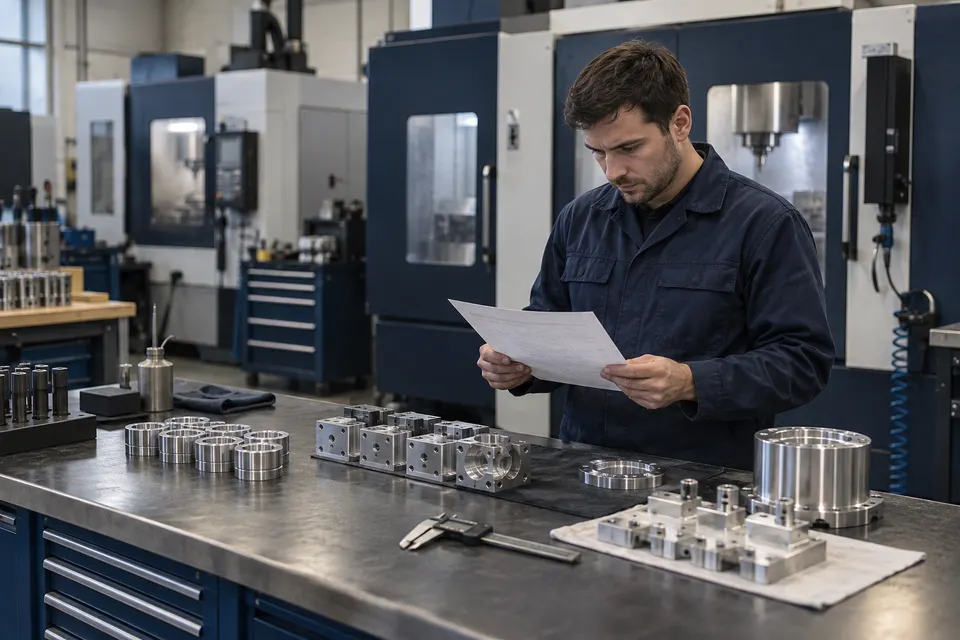
Use representative inputs from the business to scope workflow automation. Agree what the system prepares and what a person needs to check.

Test normal work, missing information and failures with the team, then hand over clear review steps and practical guidance.
On-site time with the people who actually do each handover. Where the friction is. Where exceptions are handled informally. Where "we always do X" lives.
Order intake to planning, planning to material order, completion to dispatch. Email parsing, API integration, or RPA where needed.
Where the workflow needs judgement (which supplier, which production line, which customer to update) AI proposes and a human confirms. Confidence thresholds tune over time.
Audit trail on every action. Alerts when a step is overdue. Rollback for anything affecting money or customer commitments. The system runs reliably over weekends.
We check your software version, available API or export, access permissions and any supplier fees before quoting. If a reliable connection is not available, we will explain the practical alternatives.
One repeatable process with its trigger, current handovers, required approvals and common failure cases.
Measure completion time, missed handovers and manual interventions for one workflow before extending it.
Agree who can approve each action and who receives failures. Keep a manual fallback for supplier or system outages.
£4,800-£30,000+ depending on workflow complexity and integrations
From £4,800excluding VAT
Workflow automation for manufacturers
No, it works with your ERP. We extend the workflows your ERP doesn't cover (or covers awkwardly) and connect the gaps. Most clients find the ERP becomes more useful, not less, after we add the automation layer on top.
Edge cases route to a human with full context. The automation handles the 90% standard flow; exceptions get human attention with all relevant info in one screen. The system learns from how exceptions are resolved over time.
Typically 8-16 weeks for an end-to-end workflow. We deliver in phases, first workflow live in 6-8 weeks, then expand. You see value during the build, not at the end.
Yes, every step is logged, monitored, and alerted on. When something fails, the right person is notified within minutes. Less fragile than the manual process it replaces, because errors get caught immediately rather than discovered three days later.
Designed for change. Steps are modular. You can update supplier lists, approval thresholds, notification rules without rewriting. We hand over codebase and docs so your team or another developer can maintain.
Keep exploring
A new website. More customers. Less admin.
Tell us where you want to get to. We will reply within one working day.