What we need to see
One repeatable process with its trigger, current handovers, required approvals and common failure cases.

Workflow automation · Fabricators
Fabrication work has natural workflow stages, order, materials, cut, weld, finish, QC, dispatch. The mechanical handovers between stages are exactly what AI and automation handle best. We built a production workflow engine for Kingsland Fabrications that covers 8 stages end-to-end, with automatic supplier orders, customer scheduling, and manager assignment.
Tell us the task, your current tools and where the work gets stuck. We will help you choose a sensible first scope.

Every fabrication shop runs on a daily standup, a whiteboard, and one or two people who hold the whole picture in their head. When they're ill, on holiday, or buried, jobs slip. Material ordering misses windows. Customer updates don't go out. Delivery notes get printed but not actioned. The cost isn't one big mistake, it's 50 small ones a week that add up to lost margin and frustrated customers.
The work in context · Illustrative scenes
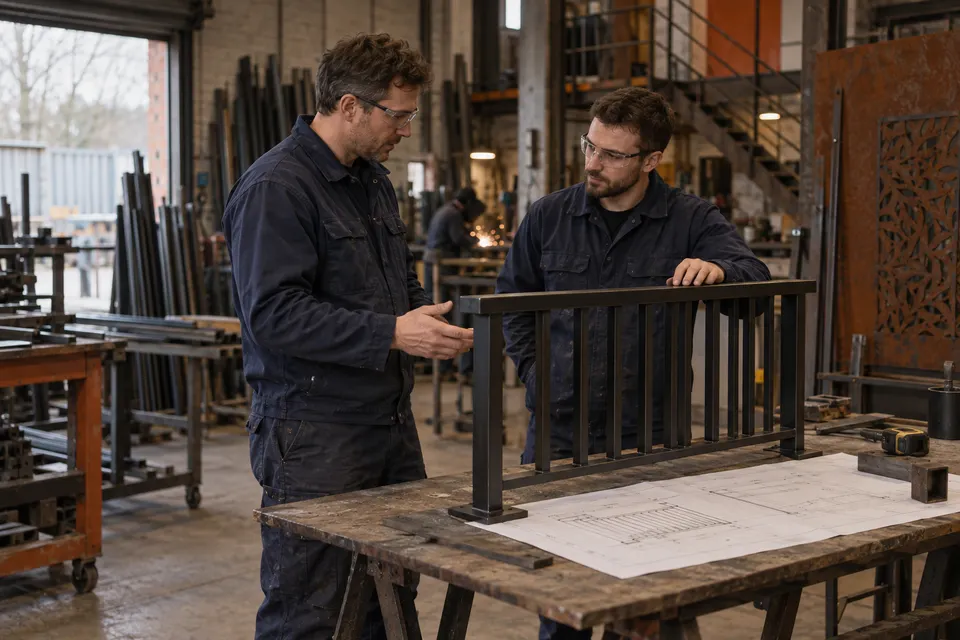
Use representative inputs from the business to scope workflow automation. Agree what the system prepares and what a person needs to check.

Test normal work, missing information and failures with the team, then hand over clear review steps and practical guidance.
See the business context and the work delivered. Your own scope, inputs and results will depend on the workflow we agree with you.
Explore the delivered workTwo days walking through the shop with the people who actually do the work. Where the handovers are. Where the exceptions are. Where the "we always do X" decisions live that aren't written anywhere.
For each stage: what triggers it, what data flows in, what action gets taken, what triggers the next stage. Automatic where rules are clear. Manager attention where judgement is needed.
Glass orders go to suppliers automatically on the right schedule. Customer scheduling links sent at the right point in the workflow. Delivery notes generated and routed.
Operational analytics on the production state, what's where, what's late, what's next. Available to office and shop floor through the internal AI assistant.
We check your software version, available API or export, access permissions and any supplier fees before quoting. If a reliable connection is not available, we will explain the practical alternatives.
One repeatable process with its trigger, current handovers, required approvals and common failure cases.
Measure completion time, missed handovers and manual interventions for one workflow before extending it.
Agree who can approve each action and who receives failures. Keep a manual fallback for supplier or system outages.
£4,800-£25,000+ depending on workflow complexity and integrations
From £4,800excluding VAT
Workflow automation for fabricators
Always with the workflow stage that's costing you the most time today. We map the current state, identify the 2-3 biggest leaks, and build to fix those first. Other stages follow once the first is stable.
Yes. The automation sits on top of your MES, reading and writing where needed. Some clients use our system to extend a basic MES; others use it to replace spreadsheet workflows that the MES never covered.
The automation is modular, you can change supplier lists, approval thresholds, notification rules without rewriting the whole thing. We hand over codebase and documentation so your team or another developer can maintain it.
Less fragile than the manual process it replaces, because every step is logged and monitored. When a step fails, you know in minutes, versus discovering Wednesday that nobody emailed the supplier on Monday.
Edge cases route to a manager with the right context. The automation handles the 90% standard flow; the 10% edge cases get human attention with all the relevant info in one screen rather than scattered across systems.
Keep exploring
A new website. More customers. Less admin.
Tell us where you want to get to. We will reply within one working day.