Refreshed 14 July 2026: Published Kingsland Fabrications results include paint-note work reduced from roughly two hours a day to near zero, invoice review compressed from hours into a minutes-class exception check, and a custom MES supporting growth without an increased wage bill. See the invoice matching use case and fabrication invoice-matching solution.
If you run a fabrication shop and you’ve been wondering what an “applied AI consultancy” actually does, past the marketing copy and the demo videos, this article is for you.
Below are six AI projects we’ve built for a single client: Kingsland Fabrications, a steel fabrication specialist in Warrington. Every one is running in production. Every one was built fixed-price. Every one saves real time, every week, in a working factory. None of them are demos or prototypes. See the full Kingsland story and the new use-case hubs for the patterns you can copy: Invoice matching for fabricators and the dedicated solutions for fabrication.
I’m writing them up because most “AI for manufacturing” content online describes things that could exist. These exist. They’ve been live for months.
The shop, the constraint
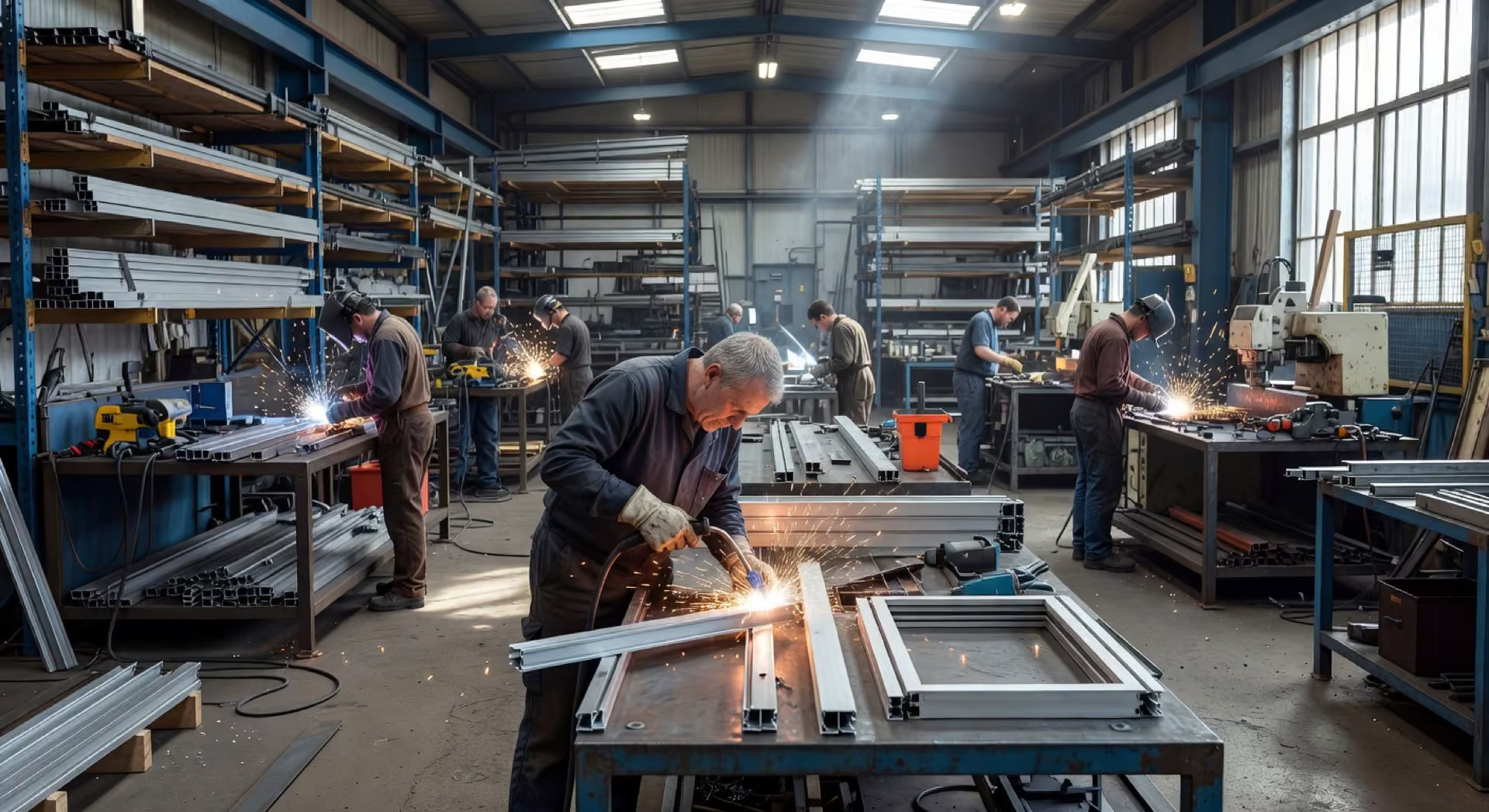
Kingsland is a typical mid-sized UK fabricator. Strong technical capability, long-standing customers, growing book of work. The constraint wasn’t the metalwork, it was the paper. Production paperwork, invoice verification, paint specs, drawing references, supervisor admin, customer chasing. Hours of senior staff time disappearing every week into work that didn’t make a single finished job.
This is where AI actually earns its money in manufacturing. Not in flashy demos, in unblocking the bottlenecks that nobody has time to fix.
1. Invoice verification and PO matching
The problem: every supplier invoice arriving at Kingsland needed checking line-by-line against the original purchase order. Quantities, prices, part numbers, three things that go wrong on every other invoice. Office staff were spending 15-30 minutes per PO on this, and they were still missing things, because human attention falters at scale.
What we built: an OCR pipeline that reads each supplier invoice (PDF or photo), extracts the line items, and does a three-pass match against the original PO. Mismatches are flagged with the specific discrepancy (“part X-447 quantity invoiced 12, ordered 10”). Office staff get a one-click approve or reject queue.
Result: 15-30 minutes per PO became seconds. Office staff went from being the bottleneck to having capacity for higher-value work. As a bonus, the same pipeline now handles material check-in: when goods arrive, photos of the delivery note are automatically reconciled against the PO. Wrong deliveries are caught at the gate, not three weeks later when the job is on the shop floor.
Build time: ~3 weeks to production. Fixed price.
2. Paint notes from cut lists
The problem: every job required a “paint note”, a document sent to the powder coater listing exactly which parts to coat, in what colour, in what quantities, with notes on hanging and exclusions. The cut list (a PDF from the design system) had to be read by hand, the relevant items grouped by paint category, exclusions worked out, and the document typed into Word. The shop-floor supervisor was spending up to 2 hours a day on this, every day.
What we built: a Mistral OCR model reads the cut-list PDF and extracts every line item with its dimensions, profile, finish, and category. A processing layer groups them into the paint-note format Kingsland’s powder coaters expect, automatically calculates hanging allowance, detects exclusions, and outputs a print-ready document. The supervisor reviews and approves; never types a paint note again.
Result: 2 hours per day → about 5 minutes (review only). The supervisor went from being the bottleneck for paint dispatch to never being asked. The same pipeline now also extracts glass orders from the same cut lists, another job that used to be done by hand.
Build time: 2-4 weeks. Phased pricing. The interesting bit: cut-list formatting varies more than anyone admits, so the first version needed real prompt iteration and validation logic. This is why we don’t sell “AI in 7 days”, for a fabrication shop, the realistic timeline is weeks, not days, because we have to hit production-grade reliability with formatting variation, not get a demo working on perfect input.
3. Photo-based quality control
The problem: quality control on fabrication is partly objective (dimensions, drilled holes, fixings) and partly subjective (surface defects, coating quality, assembly cleanliness). The subjective half is where consistency drifts, different inspectors, different days, different decisions. And it’s a job nobody on the shop floor wants to be the bottleneck for.
What we built: an AI vision model that analyses QC photos taken on the shop floor for surface defects, coating issues, structural concerns, and assembly problems. Each finding gets a severity rating. Anything above a configurable threshold is flagged for human review; everything else passes through. The objective checks (count, dimensions, fixings) are also automated where the photo can confirm them.
Result: consistent QC across all inspectors. Fewer “in dispute” jobs reaching the customer. A clear paper trail for any defect found, with photo evidence, severity rating, and reviewer sign-off.
Build time: ~4 weeks.
4. Conversational AI assistant
The problem: shop-floor supervisors and managers spend their day answering the same questions. Where is job 4471? When was material X received? Has the paint note for job 4520 gone out yet? Who’s chasing customer Y? The information is in the system, but pulling it out takes clicks. So people interrupt other people. Every interruption costs minutes and breaks concentration.
What we built: a conversational AI assistant with twenty specialised tools across information lookup, actions, document handling, and stage management. Anyone can ask in natural language (“what’s the status of job 4471”, “when did the X-447 profile arrive”, “send paint note for 4520”). Role-based access controls who can do what. Anything that takes an action requires a two-step confirmation.
Result: the supervisor’s phone stops ringing for status questions. The assistant becomes the first port of call for anyone needing information. The actual humans get to focus on actual decisions.
Build time: ~6 weeks for the initial twenty tools, with new tools added on demand.
5. Workflow automation, production orchestration
The problem: moving a job through the shop touches a dozen people and a dozen systems. Manager assignment, customer scheduling, paint-note chasing, glass ordering, delivery note creation, customer notifications. Each handover is a place for things to fall through the cracks, especially when the team is flat out and someone is on holiday.
What we built: an event-driven automation engine that orchestrates the entire production workflow. Auto-assigns managers when a job is booked. Sends scheduling emails to customers automatically. Chases paint notes when they’re due. Triggers glass orders when stage gates are met. Creates delivery notes when material readiness criteria are confirmed. Has capacity intelligence to balance load across managers.
Result: zero missed orders, even during the busiest weeks. Customers get scheduling updates without anyone having to remember. The team can be at full stretch without the wheels coming off the back-office work.
Build time: rolling, built in phases, ~8 weeks for the core engine, then continuous additions.
6. Real-time analytics and KPIs
The problem: Kingsland’s leadership team wanted to know, at any given moment, what was on the shop floor, where the bottlenecks were, and whether on-time delivery was on track. The data existed across multiple systems but pulling it together meant asking three people for spreadsheets.
What we built: live dashboards refreshing every 30 seconds. On-time delivery rate, cycle time per stage, stage dwell times, hold analysis, lead-time trends. A WebSocket-driven shop floor HUD shows live job status to anyone walking past. Leadership has a separate exec view with drill-downs into the underlying data.
Result: decisions get made on numbers, not feelings. When something looks off (cycle time creeping up, dwell time on a stage spiking) it’s visible the same day, not the same quarter.
Build time: ~5 weeks for the initial dashboards, ongoing additions.
What this all cost
These six projects were not delivered in a single £50,000 initiative. They were delivered as separate, fixed-price builds over the course of a year, paired with an ongoing AI & Software Retainer (the shape we explain on our Pricing page). Each one paid back its own cost inside the first quarter of running.
For a fabrication shop wondering whether this is realistic at SME scale: yes. Kingsland is not an aerospace contractor. They’re a mid-sized aluminium fabricator with the same problems every UK fabrication shop has. The technology fit is the same.
Why this matters for your shop
Most “AI for manufacturing” content describes capabilities. The six projects above describe implementations, what got built, how long it took, what changed.
If you run a fabrication shop in Greater Manchester, Yorkshire, the Midlands, or anywhere across the UK, and any of the bottlenecks in this article sound familiar, the paint note that one supervisor is the only person who knows how to do, the invoices that pile up because nobody has time to verify them properly, the QC drift across different inspectors, the same status question fielded twenty times a day, those are the bottlenecks AI fixes for fabrication businesses today. Not someday. Now.
We’re based in Tameside, Greater Manchester. We work with fabricators across the UK. Most of our work starts with a conversation about which one of these problems is costing you the most hours.
If you want that conversation, book a 15-minute intro call or read the full Kingsland Fabrications case study for more depth on how the engagement actually shaped up.
Frequently asked questions
How much does AI consultancy for a fabrication shop cost in 2026?
Focused fixed-price AI builds typically start from £3,000 for a single document-processing pipeline and scale to £5,000-£15,000 for a multi-workflow system. Most of our fabrication clients invest between £8,000 and £30,000 across the first year, often paired with a monthly AI & Software Retainer for continuous delivery once the initial builds are live. Every project is fixed-price quoted before any work starts.
How long does it take to get the first AI project live?
A focused project, like invoice verification or paint-note generation, is typically 2-4 weeks from kickoff to production use. More complex multi-workflow builds (production orchestration, conversational assistants) take 6-8 weeks. We don’t sell 7-day delivery promises because production-grade AI for manufacturing requires real validation against real data, and shortcuts show up later as missed jobs and angry customers.
Will AI replace any of our staff?
No. Every project above freed up senior staff time, the supervisor who was spending two hours a day on paint notes, the office team checking invoices, the QC inspector trying to be consistent. The AI does the repetitive work nobody wanted; the humans do the skilled work the business actually pays for.
Do we need to change our existing systems before AI can be added?
No. Every Kingsland project was built on top of the systems they already had. We integrate with what’s there (accounting, ERP, MES, Google Workspace, Microsoft 365) rather than asking you to migrate first. If a system upgrade would unlock more value, we’ll say so, but it’s never a precondition.
Are these projects realistic for a smaller fabrication shop than Kingsland?
Yes. The smallest of the six projects (paint-note generation alone) costs £3,000-£5,000 fixed price and pays back inside the first quarter for any shop where one person is doing 1+ hours a day of admin a machine could handle. Even a 5-person fabrication shop has bottlenecks that fit this shape.
We build custom software and bespoke AI tools around how your business works: customer portals, quote systems, internal tools, document checks and connected workflows. If an existing product does the job, we will recommend it. AI belongs where it adds value, with your rules and approvals built in.
Explore the serviceTell us what you want to improve →
Also relevant: AI Agents