


There’s a government-backed programme that gives manufacturers up to 50% match funding for digital technology projects, plus free expert advice on where to start. It’s been running since 2019 in the North West and has since expanded to other regions. And most manufacturers we speak to have never heard of it.
It’s called Made Smarter. And if you’re an SME manufacturer thinking about investing in new technology — whether that’s AI, automation, a new website, or better systems — it’s worth ten minutes of your time to understand what’s available.
What Made Smarter actually is
Made Smarter is a UK government programme designed to help small and medium-sized manufacturers adopt digital technology. It’s funded by UKRI (UK Research and Innovation) and delivered through regional partnerships.
The idea is straightforward. Most small manufacturers know they should be investing in technology but face two barriers: they’re not sure where to start, and the upfront cost feels risky. Made Smarter tackles both.
The programme offers three things:
Free, impartial digital transformation advice. You get access to a technology adviser who visits your business, understands your operations, and helps you identify where digital technology would make the biggest difference. This isn’t a sales pitch for any particular product — it’s genuine, expert guidance tailored to your business.
Match funding of up to 50% for digital technology projects. If you identify a technology investment that will improve your business, Made Smarter can fund up to half the cost. The maximum grant varies by region and year, but it’s typically between £2,000 and £20,000 of funded support. You put in the other half.
Leadership and skills development. Workshops and training programmes to help manufacturers develop the skills and knowledge they need to get the most out of new technology.
The programme has already supported thousands of manufacturers across the UK. The results have been strong enough that the government has continued to expand it.
Who’s eligible
The eligibility criteria are fairly clear, though they vary slightly by region:
You must be a manufacturing SME — that means a business that makes physical products, with fewer than 250 employees. This covers a broad range: fabrication, machining, food manufacturing, plastics, packaging, electronics, textiles, and more.
You must be based in an eligible region. The programme started in the North West and has expanded to the North East, Yorkshire and Humber, West Midlands, and East Midlands. Other regions may follow. If you’re a manufacturer in Greater Manchester, Lancashire, Cheshire, Cumbria, or Merseyside, you’re in the original North West cohort.
You must have been trading for at least one year and be able to match fund the project — meaning you can cover at least half the cost yourself.
You should not have already adopted the technology you’re applying for. The programme is about helping manufacturers take a new step, not funding something you’ve already done.
If you’re not sure whether you qualify, the simplest thing is to register your interest on the Made Smarter website. They’ll tell you quickly.
What it covers
This is where it gets interesting. The range of eligible technology is broader than most people expect.
AI and machine learning. Systems that use artificial intelligence to improve quality control, predict maintenance needs, process documents, or automate decision-making. This includes AI agents that handle repetitive tasks, document processing systems, and predictive analytics.
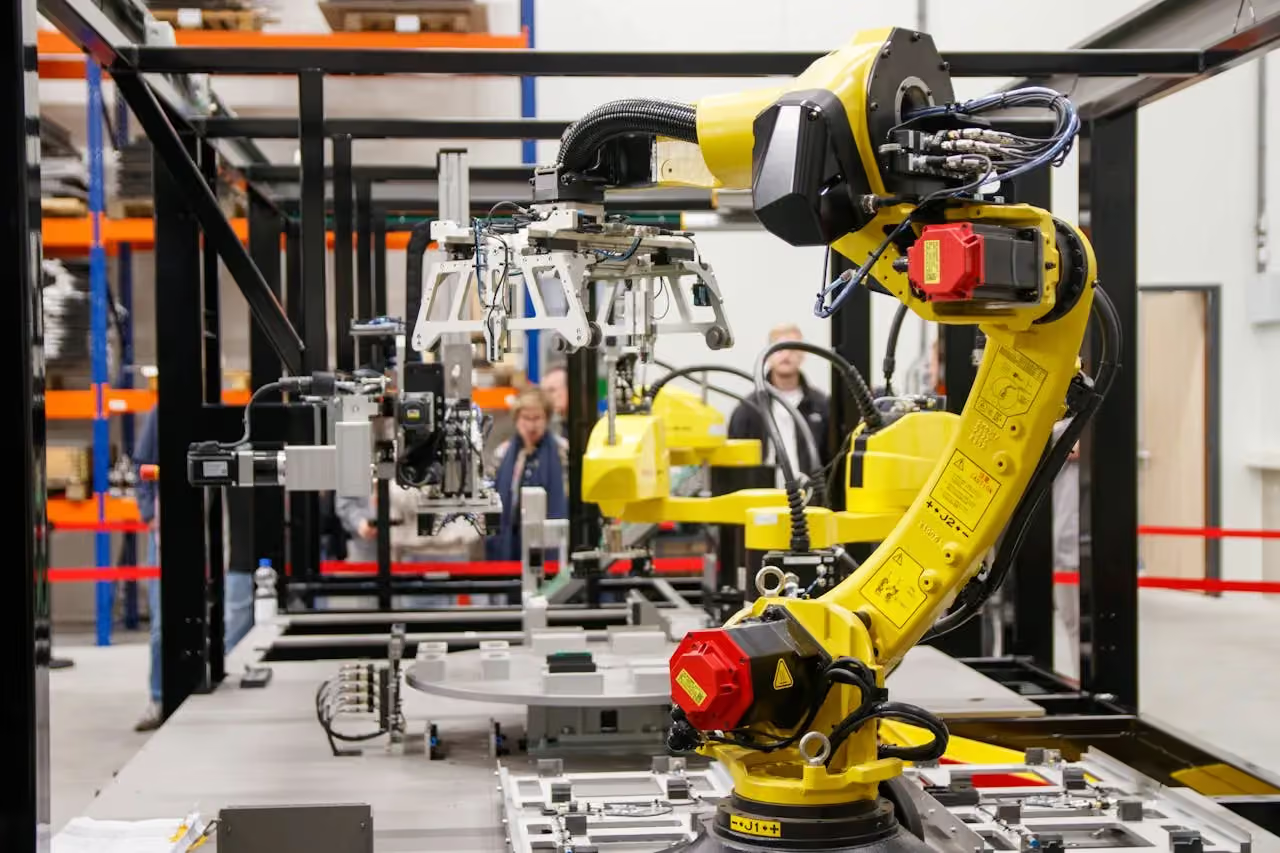
Automation and robotics. Collaborative robots (cobots), automated assembly lines, pick-and-place systems, and other automation that reduces manual handling or increases throughput.
IoT and sensors. Connected sensors that monitor machines, track production in real time, measure energy consumption, or provide data for better decision-making. Think of it as giving your equipment the ability to tell you what’s happening without someone having to go and check.
Data analytics and dashboards. Systems that collect data from your operations and present it in a useful way — production rates, downtime, quality metrics, delivery performance. You can’t improve what you can’t measure.
Cloud computing and digital systems. Moving from spreadsheets and paper to proper digital systems. This can include ERP systems, job management software, digital quality management, and cloud-based collaboration tools.
3D printing and additive manufacturing. For prototyping, tooling, jigs, fixtures, or short-run production parts.
Augmented and virtual reality. For training, remote assistance, or product visualisation.
Websites and e-commerce platforms. In some regions and some programme years, websites that directly support digital transformation goals have been eligible. If your current website is holding back your ability to reach customers or present your capabilities, it’s worth discussing with your Made Smarter adviser.
The key requirement is that the technology must demonstrably improve your business — whether that’s increasing productivity, reducing costs, improving quality, growing revenue, or some combination.
How the application process works
Less bureaucratic than you’d expect from a government programme.
Register your interest. Fill in the form on the Made Smarter website. Five minutes.
Meet your adviser. A technology specialist visits your business or arranges a call. They learn about your operations, pain points, and goals. This is free — even if you don’t apply for funding, the advice is valuable.
Develop your project plan. Working with your adviser, you identify the technology project and develop a clear plan with expected benefits, timeline, and costs. You don’t need to write a detailed technical proposal from scratch.
Submit your application. Based on the work you’ve already done with your adviser. They help you through it.
Decision and delivery. Applications are reviewed on a rolling basis — no annual funding rounds. Once approved, you proceed and claim the funding as agreed.
The whole process typically takes four to eight weeks from first contact to approval.
What you need to have ready
A clear idea of where your bottlenecks are. You don’t need to know the exact solution — that’s what the adviser helps with. But “we spend 20 hours a week on manual data entry” gives them something concrete.
Basic financial information — turnover, employee count, trading history. Just the basics for eligibility.
A willingness to co-invest. You need to cover at least half the cost. Not cash in hand on day one, but genuine commitment to the investment.
North West specifics
The North West was the pilot region, and the programme here is the most established. It’s delivered by the Growth Company in partnership with Lancaster University.
For manufacturers in Greater Manchester, Lancashire, Cheshire, Cumbria, and Merseyside, the programme has been running since 2019 and has supported over a thousand businesses. The advisers have deep experience with local manufacturing challenges — fabrication, machining, food manufacturing, textiles.
The North West programme also runs regular workshops and showcase events where you can meet manufacturers who’ve been through the process. Talking to someone who’s actually implemented the technology is often more useful than any amount of programme literature.
Is it worth the effort?
Bluntly: yes.
The advisory service alone is worth your time, even if you don’t apply for funding. Free, impartial expert advice with no obligation.
The funding is real money. A £10,000 project that costs you £5,000 out of pocket, with clear productivity benefits, is a straightforward business case. The risk is low — worst case, you get free advice and decide the timing isn’t right. Best case, the government covers half a transformative project.
If you’re a manufacturer in the North West thinking about digital technology — AI, automation, new systems — Made Smarter is the first conversation you should have.
And if you want to discuss what an AI or digital project might look like before approaching Made Smarter, book a consultation with us. We’ve worked with manufacturers on exactly the kinds of projects the programme supports.
Frequently asked questions
How much funding can I get from Made Smarter?
The match funding is typically up to 50% of the project cost, with grant amounts usually ranging between £2,000 and £20,000 depending on your region and the specific programme year. The exact maximum varies, so check with your regional Made Smarter team for current figures. You’ll need to cover the other half of the cost yourself.
Can I use Made Smarter funding for a website?
It depends on the region and the specific project. If a website is part of a broader digital transformation — for example, an e-commerce platform that opens a new sales channel, or a customer portal that digitises your ordering process — it’s more likely to qualify. A standard brochure website on its own may not meet the criteria. Discuss it with your Made Smarter adviser, who can tell you what’s eligible in your region.
How long does the Made Smarter application take?
From initial registration to funding approval, the process typically takes four to eight weeks. There’s no annual deadline or competitive round — applications are assessed on a rolling basis, so you can start at any time. The main factors affecting timing are how quickly you can develop your project plan with your adviser and how responsive you are in providing the required information.
Is Made Smarter only for large manufacturers?
No — in fact, the programme is specifically designed for SME manufacturers. The majority of businesses supported have fewer than 50 employees, and many have fewer than 20. You don’t need to be a large operation to benefit. Some of the most impactful projects have been in small workshops where a relatively modest technology investment has transformed a key process.